
Open a sack of good Gujarat cumin and you know it before you look at it. The smell hits first: warm, earthy, a little nutty, with that sharp edge that makes you think of tadka crackling in hot ghee. Then you see the seed itself, long and slim, greenish-brown, with fine ridges running along its length.
That first impression is exactly what buyers in Dubai, Rotterdam, Houston and Singapore are paying for. Cumin is one of the most traded spices in the world, and India grows the large majority of it. Within India, Gujarat sits at the centre of the trade, both as a growing region and as the place where most export lots are cleaned, graded and packed.
But “Gujarat cumin” is not one single product. Two lots from the same village can look similar and still be worlds apart in purity, oil content and safety. For an importer, knowing what separates a premium lot from an average one is the difference between a happy customer and a rejected container.
In this guide, we walk you through what really defines cumin quality, from the farm to the container. Whether you are a first-time buyer or a seasoned importer, we hope it helps you ask sharper questions and buy with confidence.
Where Gujarat cumin comes from
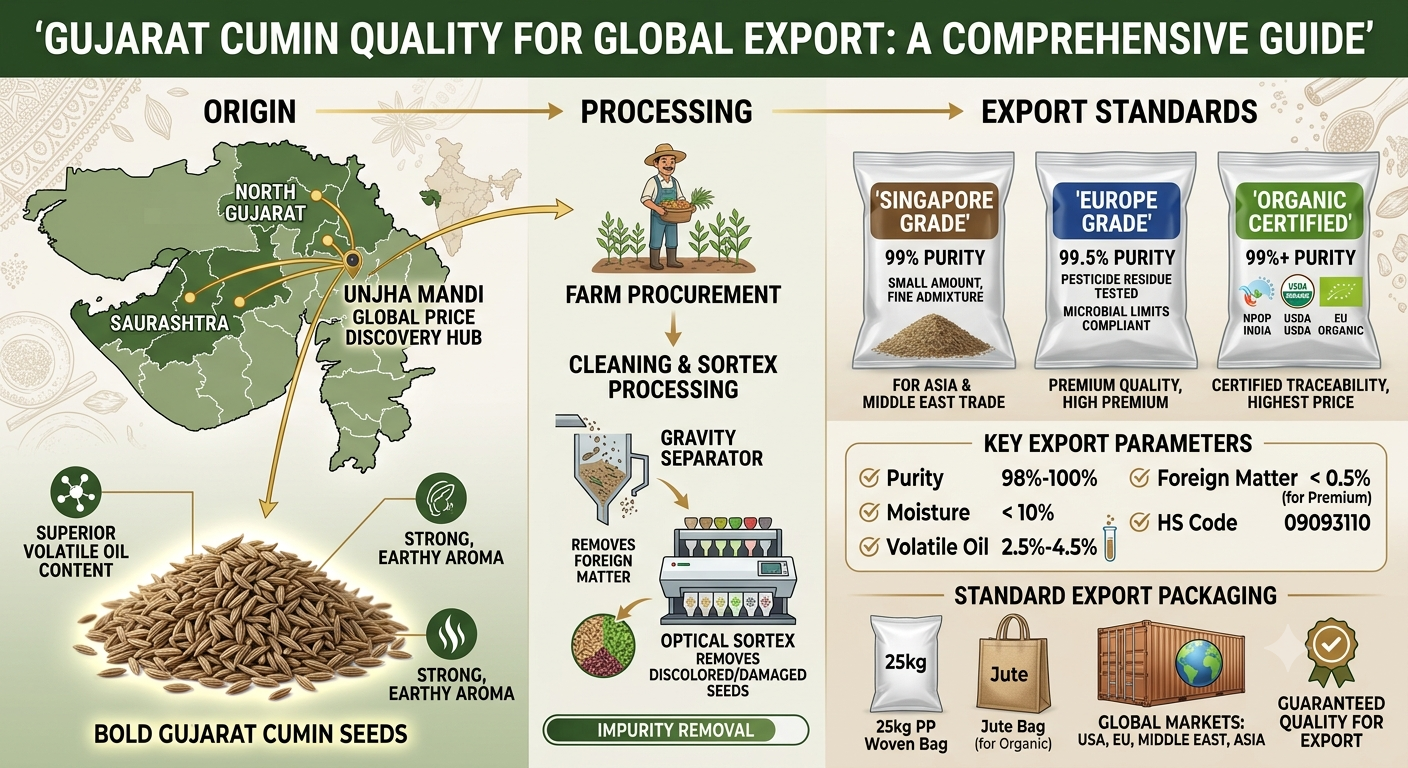
Cumin is a winter crop. Farmers sow it in November, once the monsoon heat has gone, and harvest it in February and March. The plant likes cool, dry days, clear skies and very little rain while it flowers and sets seed. Too much moisture or cloud at that stage brings disease, and that shows up later as dull, weak seed.
Gujarat happens to offer those conditions across a wide belt:
- North Gujarat – Mehsana, Banaskantha, Patan and Sabarkantha districts, the traditional heartland of the crop.
- Saurashtra – Rajkot, Surendranagar, Jamnagar, Morbi and Amreli, which have grown steadily in area over the past two decades.
- Kutch – dry, sunny and well suited to a crop that hates humidity, with a growing share of the state’s acreage.
All roads lead to Unjha, a small town in Mehsana district that hosts one of the biggest spice markets in Asia. Its APMC yard sets the tone for cumin prices across India and much of the world. Fresh arrivals usually peak between March and May, and that is when buyers can see the most choice in colour, size and grade.
For importers, this matters for one simple reason: the region, the season and the weather at harvest all leave a mark on the seed. A good exporter will tell you which belt a lot came from and what the harvest season was like.
The varieties behind the seed
Most cumin grown in Gujarat today comes from improved varieties bred by Gujarat’s agricultural universities, especially the cumin research station at Jagudan under Sardarkrushinagar Dantiwada Agricultural University. Their names start with “GC”, short for Gujarat Cumin.
GC-4 is the one you will hear about most often. It became popular because it resists wilt, a soil-borne disease that used to wipe out whole fields. Better plant health usually means bolder, more even seed with good colour. Other varieties such as GC-1, GC-2, GC-3 and newer releases are still grown in pockets.
You will also see cumin from neighbouring Rajasthan in the Unjha market. Rajasthan grows a large share of India’s crop, and much of it is traded and processed in Gujarat. Both origins can produce excellent cumin. The differences tend to be in seed size, colour and harvest timing rather than in one being simply “better”.
What this means for buyers: ask for the specification, not just the origin label. A clean, well-graded lot is worth more than a famous name on the bag.
Export grades explained
In the cumin trade, grade names are shorthand for how clean the seed is. They are not legal standards, so exact numbers vary slightly between exporters. Still, the market broadly understands them like this:
Grade | Typical purity | What to expect | Common markets |
|---|---|---|---|
Sortex / 99.5% | 99.5% or higher | Colour-sorted, very uniform, almost no foreign matter | EU, UK, US, Japan, premium blenders |
Europe quality | 99% | Machine cleaned and graded, low admixture | Europe, North America |
Singapore quality | 98% | Cleaned, small allowance for broken seed and other matter | Middle East, Southeast Asia, re-export hubs |
Machine cleaned | 96–98% | Basic cleaning, more variation in size and colour | Price-driven buyers, further processing |
A few things are worth knowing behind these labels.
Purity is about what is not cumin. That includes dust, stones, stems, broken seed, and seeds of other plants, often called admixture. A 98% lot can be perfectly fine for a grinder who will process it again. A spice brand packing whole cumin for supermarket shelves usually needs 99% or better.
Sortex is a process, not a variety. Sortex refers to optical colour sorting machines that reject seeds that are too dark, too pale or the wrong shape. It is what gives premium lots their even, attractive look.
Agree the specification in writing. Always put purity, admixture, moisture and any lab tests in the contract. “Europe quality” from one supplier may not equal “Europe quality” from another.
The quality parameters that really matter
Beyond the grade name, experienced buyers look at a handful of measurable points. These are the ones we check on every lot before it leaves our warehouse.
Parameter | Typical export target | Why it matters |
|---|---|---|
Purity | 98% to 99.5%, by grade | Sets the price and how much cleaning the buyer must do |
Admixture / foreign matter | 0.5% to 2% max, by grade | Stones, stems and other seeds reduce yield and can damage grinders |
Moisture | Around 8% to 10% max | Higher moisture invites mould and weight loss in transit |
Volatile oil | Usually 2.5% or more for premium lots | Carries the aroma; low oil means flat, weak flavour |
Total ash | Within the buyer’s or ISO limit | High ash points to sand and soil left in the lot |
Colour and size | Even greenish-brown, bold seed | Shoppers judge whole cumin by eye |
Aroma is the soul of cumin. Most of cumin’s flavour comes from its essential oil, and the main compound in it, cuminaldehyde, gives that familiar warm smell. Fresh, well-stored seed rubbed between your palms should release a strong, clean scent. A musty or dusty smell is a warning sign.
Moisture is the silent risk. Cumin may leave India in perfect condition and still arrive damaged if it was packed too wet. Long voyages through hot, humid ports can turn a small moisture problem into mould, caking and failed lab tests.
Look at the seed, not just the report. Ask for a sealed pre-shipment sample. Spread it on a white sheet of paper, check for dust, broken seed and odd colours, and smell it. Ten minutes with a sample can save months of trouble.
Food safety and compliance: the part buyers cannot skip
A few years ago, a buyer might have accepted a lot on looks and smell alone. Not anymore. Importing countries now test spices closely, and a single failed test can mean a rejected container, a border alert and a damaged reputation for both buyer and seller.
These are the safety checks that serious importers ask for:
- Pesticide residues. The European Union, the UK, the US and Japan all set maximum residue limits (MRLs). EU limits are among the strictest in the world. A lot that is fine for one market may fail in another, so the destination must be clear before testing.
- Aflatoxins and ochratoxin A. These are toxins produced by moulds when seed is stored damp or warm. They are invisible, so only a lab test can confirm a lot is within limits.
- Microbiology. Salmonella, E. coli and total plate count are common checks, especially for the US and EU. Many buyers now ask for steam-sterilised cumin for this reason.
- Heavy metals and adulteration. Some buyers test for lead and other metals, and for added colour or foreign seed made to look like cumin.
On the Indian side, export cumin is handled within a framework set by the Spices Board of India, which registers spice exporters and runs testing and certification for spice consignments. FSSAI governs food safety standards in India, and APEDA supports agricultural exports more broadly.
Our advice is simple. Ask your supplier for a recent report from an accredited lab (NABL-accredited in India, or an internationally recognised lab such as SGS, Eurofins or Intertek). Make sure the report matches your lot number, not just a similar product from last season.
From the farm to the container
Quality is not added at the end. It is protected, or lost, at every step. Here is how a typical export lot of Gujarat cumin moves from field to port:
- Harvest and drying. Farmers cut the plants when the seed turns brownish and dry them in the sun before threshing. Rain at this stage is the biggest risk to colour and to mould.
- Market purchase. Exporters and their agents buy at Unjha and other APMC yards, checking samples for colour, smell, size and visible dirt.
- Pre-cleaning. The raw seed passes through sieves and air blowers that remove dust, stems, stones and light material.
- Gravity separation and destoning. Gravity tables separate heavy stones and light, hollow seeds, leaving bold and well-filled grains.
- Sortex colour sorting. For premium grades, optical sorters reject discoloured, damaged or off-type seed.
- Steam sterilisation (on request). Many buyers in the EU and US ask for steam-treated cumin to reduce microbial load without chemicals.
- Lab testing. Samples go to an accredited lab for purity, moisture, residues, toxins and microbiology, as agreed with the buyer.
- Packing and loading. The approved lot is packed, labelled with lot details and loaded into a clean, dry container.
Packaging, documents and shipping
Good cumin can still be spoiled by poor packing. Most export lots travel in new 25 kg or 50 kg PP bags, jute bags, or multi-wall paper bags, often with an inner liner to keep out moisture. Retail and private-label buyers may want smaller vacuum or nitrogen-flushed packs.
Inside the container, small details make a big difference. Bags should sit on pallets or kraft paper, away from the walls. Desiccant strips or bags help absorb moisture that builds up as the container moves between hot and cool climates. Most Gujarat cumin ships from Mundra or Nhava Sheva, and a standard 20-foot container usually holds around 16 to 18 tonnes, depending on bag type.
On the paperwork side, a typical shipment comes with:
- Commercial invoice and packing list
- Bill of lading
- Certificate of origin
- Phytosanitary certificate
- Lab analysis report (and Spices Board certificate where required)
- Fumigation certificate, if the buyer or destination asks for it
Accurate documents are part of quality too. A spelling error or a missing certificate can hold a container at the port for days.
A practical checklist for buyers
If you are choosing a cumin supplier from Gujarat, these questions will tell you a lot in a short time:
- Is the exporter registered with the Spices Board of India and holding a valid IEC?
- Do they run their own cleaning and sortex plant, or do they outsource processing?
- Can they share a recent lab report from an accredited lab, tied to a lot number?
- Will they test to your country’s pesticide limits, not just Indian standards?
- Do they offer steam-sterilised cumin if your market needs it?
- Will they send a sealed pre-shipment sample and accept third-party inspection?
- Do they hold food safety certifications such as FSSC 22000, BRC, HACCP or ISO 22000?
- How do they control moisture during storage and loading?
- Can they show references from buyers in your region?
A good supplier will welcome these questions. If answers are vague or slow, treat that as information too.
Buying Gujarat cumin with confidence
Gujarat cumin has earned its place in kitchens and spice blends around the world. Its aroma, colour and oil content come from the land and the winter climate. Its export quality comes from people: farmers who harvest at the right time, processors who clean it properly, and exporters who test honestly and pack with care.
When you understand grades, parameters and safety checks, you stop buying on price alone. You start buying on value, and that is where long, trusted trade relationships begin.
Looking for a reliable source of Gujarat cumin? We supply machine-cleaned, Singapore, Europe and sortex grades, packed to your specification and backed by lab reports for every shipment. [Contact our team] to request a sample, a specification sheet or a current price quote. We would be glad to help you find the right cumin for your market.